Wind Turbine
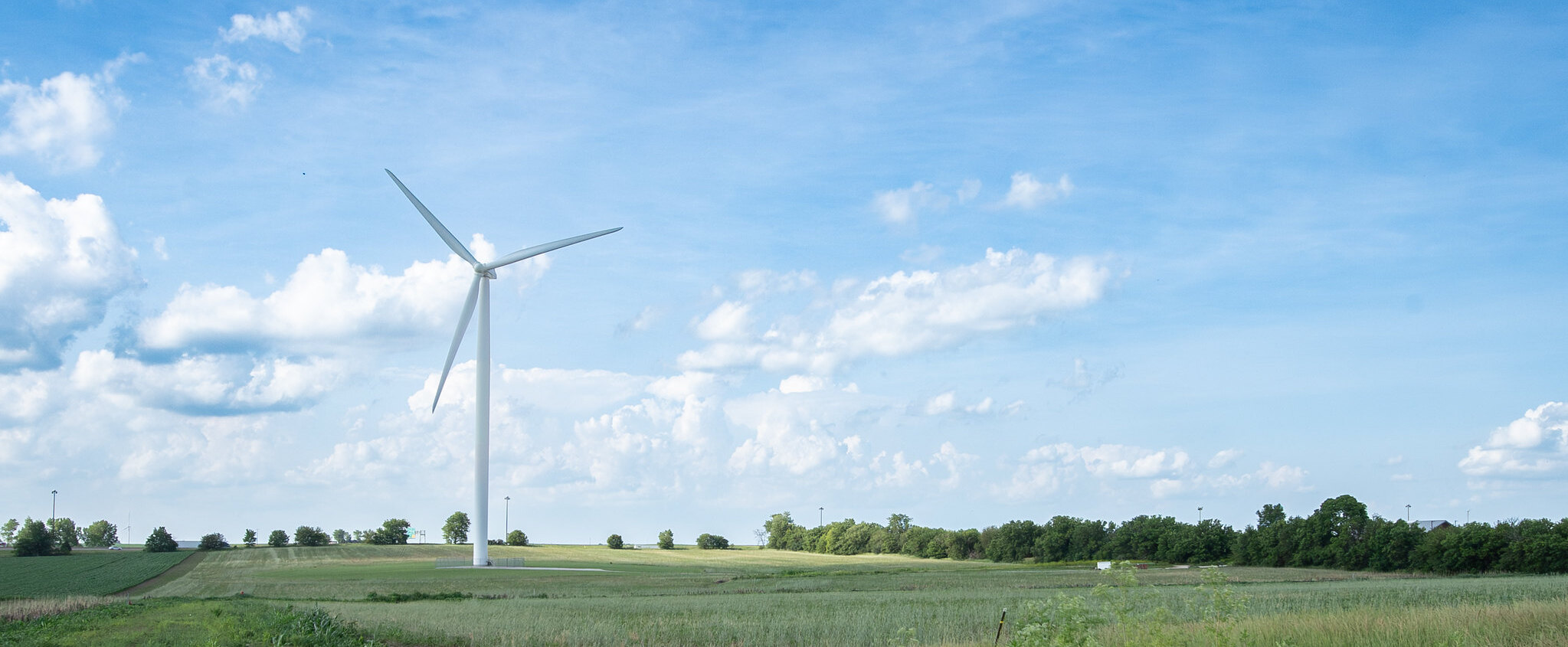
On June 12, 2012, Heartland's 1.65MW Vestas turbine began generating energy for the Normal campus.
Powering the Campus and Education
Our wind turbine generates around 60% of the electricity on campus.
It also helps prepare students for employment in the growing green economy and providing them with a better understanding of renewable energy production and energy efficiency is an important part of the overall purpose of the turbine. Funded through a grant from the Illinois Green Economy Network, we offered multiple Wind Tower Competent Climber and Rescue Trainings and we continue to offer wind energy classes as part of the REEC (Renewable Energy & Environmental Careers) program.
Turbine Fast Facts
- The Heartland Community College Board of Trustees adopted the vision of a wind turbine in 2006. View the complete timeline (PDF) of the turbine project from vision adoption to installation completion.
- It would take 11 school buses stacked end-to-end to measure up to the 390 foot turbine.
- The ladder inside the turbine is attached by powerful magnets.
- Approximately 80% of the turbine can be recycled.
- The blades can reach speeds up to 138 miles per hour. They pitch inward or outward to harvest as much wind energy as possible.
- More Fun Facts (PDF)
Waste Reduction and Recycling
Did you know 27% of what people put in the garbage can be recycled?
Recycling conserves natural resources, saves energy, creates jobs, and keeps garbage disposal fees low. Recycling helps our community!
Heartland offers a variety of ways for people to help reduce waste on campus:
- Printer cartridge and battery recycling
- Double-sided printing defaults
- Electronic recycling
Single Stream Recycling
What is single stream recycling? It means no more sorting! All standard recyclables go in the same blue bin. Heartland implemented single stream recycling in April 2013.
Here’s what you can recycle in any blue bin on campus:
| Paper | Cardboard | Glass | Metal | Plastic |
|---|---|---|---|---|
|
|
|
|
|
Here’s what you cannot recycle in blue bins:
- Greasy/soiled paper items (e.g., pizza boxes with grease stains, paper towels used to clean up a mess)
- Plastic shopping bags (please drop off at a local grocery store for proper recycling)
- #6 Plastic
- Styrofoam
LEED Certified Buildings
We are proud to have multiple Leadership in Energy and Environmental Design (LEED) certified buildings on our campus.
The College tries to accept responsibility for and reduce the campus’ environmental impact, and is committed to designing new campus construction to meet LEED standards.
- LEED Gold: National Guard Readiness Center, 2015
- LEED Certified: Workforce Development Center, 2009
- Designed to meet LEED standards (did not pursue formal certification):
- Astroth Community Education Center
- Fitness and Recreation Center
- Child Development Lab
- Shipping & Receiving
- Instructional Commons North
WDC Student Center
The College's commitment to sustainability is manifest in the WDC Student Center, the first state-funded building and the campus’ first building to seek LEED certification. Conceptualized in collaboration with area employers, the WDC supports the district's economic development through technology focused degree and certificate programs as well as customized training.
The 100,000 square foot building exemplifies green design, construction and operation in the following ways:
- Geothermal heating and cooling to optimize building energy performance
- Ventilation units that provide 100% outside air supply while efficiently recovering heat from the exhaust air stream
- Abundant use of windows including a large atrium skylight to reduce the use of artificial light sources during daylight hours
- Occupancy sensors for lighting throughout the facility
- Use of highly reflective and efficient light fixtures such as T-5 fluorescent tubes and compact fluorescent bulbs installed during construction. Updated to all smart LED fixtures during remodel projects occurring from 2022 to 2027. These LED fixtures utilize occupancy and daylight sensors to minimize electricity usage
- Sensors on bathroom fixtures to reduce water waste and keep facility more sanitary
- State-of-the-art carbon dioxide monitoring equipment to ensure high quality indoor air
- Recycled-content construction materials
- Paint, carpeting, adhesives, sealants and wood with lower levels of volatile organic compounds (VOCs)
- Ground-facing outdoor light fixtures to reduce light pollution
- Green star or other certified green furnishings
- Energy Star computers and appliances
- Recycled of over 90% of the construction waste
Agriculture Complex
Heartland's Agriculture Complex opened in January 2024. The 29,500-square-foot facility, designed by Legat Architects, demonstrates how high-performance design can reduce energy use, lower operating costs, and support workforce development.
Construction of the Ag Complex was supported by a $2M grant from the Illinois Clean Energy Community Foundation (ICEF). The grant supported project costs and building components related to energy efficiency and renewable self-generation, enabling the project to achieve site net zero energy performance.
The Ag Complex was named Green/LEED Development of the Year Award in Illinois RE Journal’s 2026 Project Awards Competition. The judging criteria for the award include the use of innovative technologies and design, a positive environmental impact including energy efficiencies and material use, and a positive economic, social, or wellness benefit to the surrounding neighborhood.
Construction and Green Space
Heartland strives to use energy, water, and material resources efficiently to minimize our negative impact on the environment utilizing thoughtful building siting, design, construction, operation, maintenance, waste removal and conservation of our green space.
Campus Facilities
The College uses a wide range of green practices to maintain and operate its facilities.
Construction
-
WDC is the first state funded building in Illinois to seek Leadership in Energy and Environmental Design (LEED) certification
-
Instructional Commons North, Receiving and Storage Building, Child Development Lab, Fitness and Recreation Center, and Astroth Community Education Center built in accordance to LEED standards
-
Normal Readiness Center (Illinois National Guard) LEED Gold certified
- Agriculture Complex designed as a Net Zero building
Engergy Conservation
-
Building automation systems increase building heating, cooling and lighting efficiency
-
Occupancy sensors turn off overhead lights when the room is not in use
-
Energy efficient T8, T5, and LED lighting, with an ongoing effort to change all campus lighting to smart LED fixtures
-
Interior exit signs are powered by LED lights
-
Double door entry vestibules that reduce loss of conditioned air
-
Desktop virtualization uses mix of thin clients and low power PCs, which draw 10 to 15 watts each, compared to 50 to 200 watts for conventional PCs
-
CRT monitors have been replaced campus wide by lower power LCD displays, which use roughly half as much power
-
Photography lab is equipped with an on-demand hot water heater to reduce energy demands
-
Thermal recovery system is employed in the HVAC system in the WDC, CDL, AGC and ACEC
-
Natural day lighting in all buildings reduces reliance on overhead lighting
-
Crosswalk signs are solar powered
-
Ground-facing outdoor lighting to reduce light pollution
Renewable Energy
-
1.65MW Wind Turbine
-
Geothermal heating and cooling at the Workforce Development Center, Child Development Lab and Normal Readiness Center
Water Conservation
-
A rainwater collection system that drains into Birky Pond
-
Bathrooms are equipped with low-flow toilets that use 1.6 gallons per flush and urinals that use 1.0 gallons per flush
-
Restroom sinks are equipped with aerators that use 0.5 gallons per minute
-
Low maintenance landscaping for efficient water use
- Prairie and Wetland areas serve as effective natural systems for conserving water and improving water quality
Green Cleaning
-
Adopted campus-wide green cleaning practices in 2007
Green Space
Before we broke ground on the Normal campus, we worked with the Illinois Department of Natural Resources to develop a habitat plan to inform and guide future grounds management.
Features of the 256 Acre campus include:
-
Restored prairie and two miles of trails – COUNTRY Financial Trail
-
Native trees
-
Birky Pond (13 acre stocked pond available for fishing)
-
Adjacent wetlands that help naturally filter storm water run-off from campus before it enters the Sugar Creek waterway
-
Grass clipping are left on the grounds to allow for nutrient recycling.
- Integrated pest management practices reduce broadcast pesticide application
For more information about Heartland’s green space, please contact HCC Facilities at (309) 268-8450 or email Amanda.Jones@heartland.edu.