| Largest Employers of Nursing Assistants | |
|---|---|
| Employer | Percentage Employed |
| Nursing Care Facilities (Skilled Nursing Facilities) |
33% |
| Hospitals; state, local, and private |
33% |
| Continuing Care Retirement Communities and Assisted Living Facilities for the Elderly |
11% |
| Home Healthcare Services |
6% |
Certified Nursing Assistant
Why Certified Nursing Assistant?
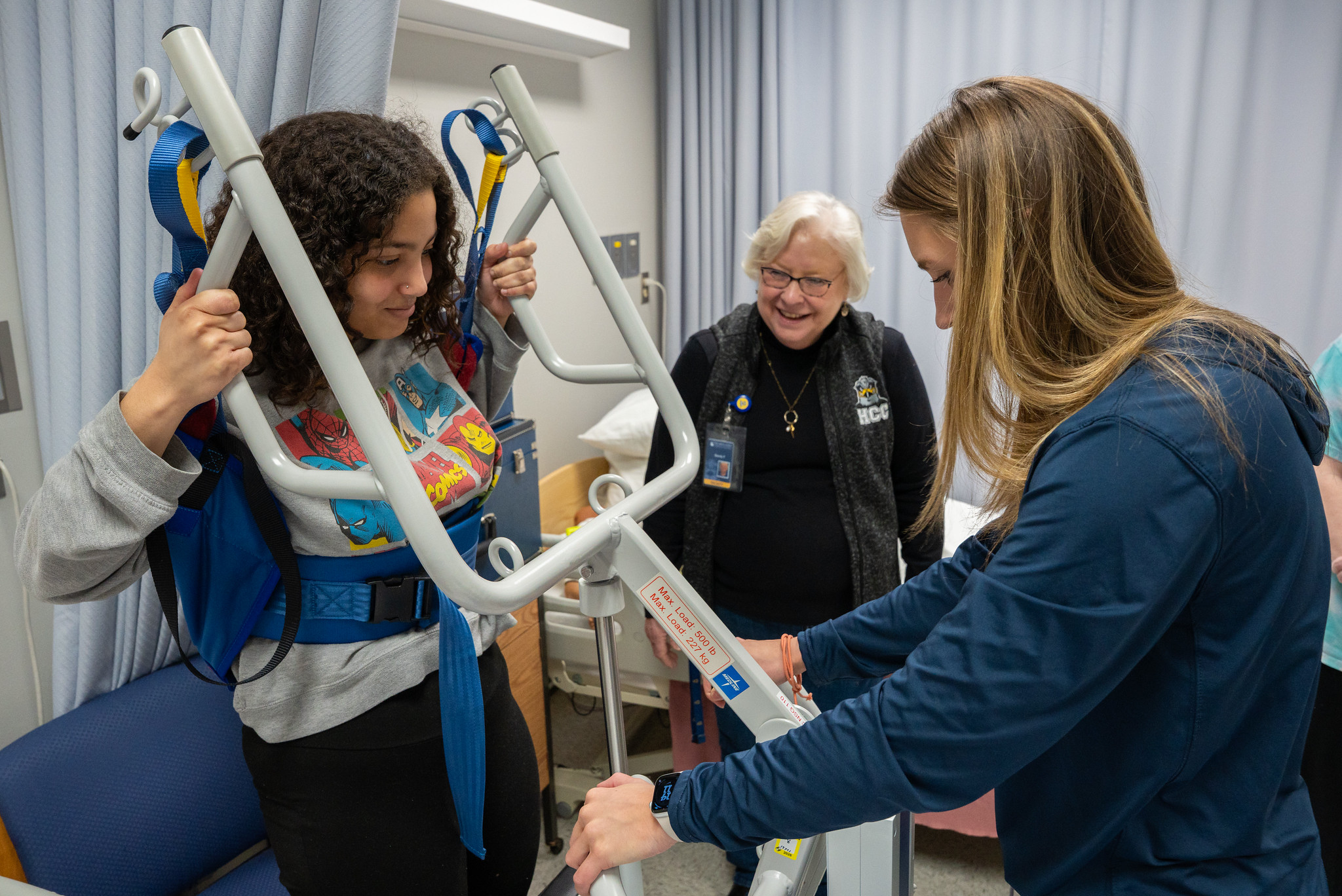
Certified Nursing Assistants (CNAs) play a very important role in nursing and offer meaningful care to others by assisting patients with bathing, dressing, eating, and other daily functions.
Through your HCC classes, you will learn to:
- make basic observations about patients that involve all body systems and their responses to treatment
- perform medical procedures such as catheter care, specimen collection, taking vital signs, and assisting with range-of-motion exercises
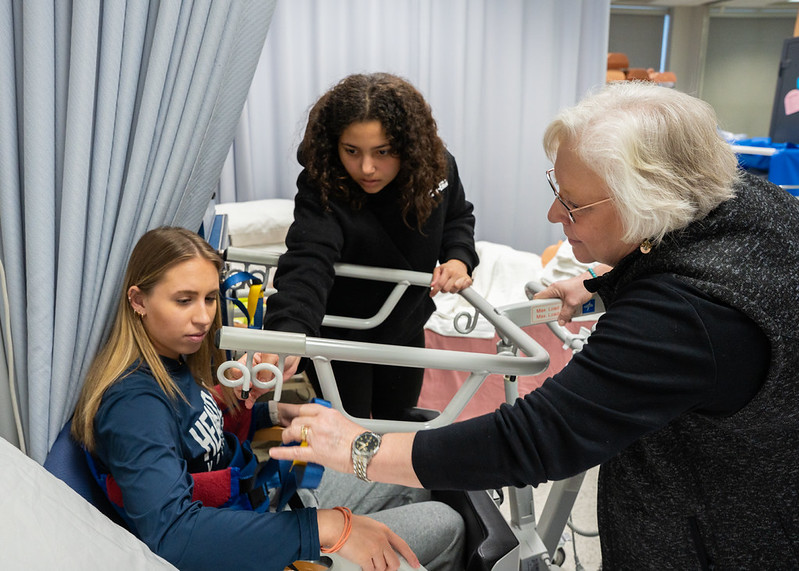
- master non-invasive procedures by practicing them with classmates
The CNA Program at Heartland Community College is a state-approved program that provides the basic foundation of nursing care for patients. Graduates work in long-term care facilities, hospitals, assisted living communities, physicians’ offices, surgical centers, and home health settings.
Contact the CNA Program Coordinator with questions.
Nursing assistants held about 1.5 million jobs in 2025.
Program Details
Certified Nursing Assistant
- Format
- On Campus, Hybrid
- In-District Tuition
- $174/credit hour
- Out-of-District Tuition
- $348/credit hour
- Nursing Assistant Certificate
- View Nursing Assistant Certificate
- Financial Considerations
- View Financial Considerations
- Mandatory Orientation
- Scheduled the week before class starts
- Check your myHeartland student email for details 4 to 5 weeks before class starts
Nursing Assistant Certificate
The Certified Nursing Assistant (CNA) Program at Heartland Community College is a state-approved program that prepares individuals to function as nursing assistants in nursing homes, hospitals, assisted living facilities, physician offices, and private homes.
The CNA Program is an 8-credit-hour program that includes 90 hours of theory and lab and 50 hours of clinical experience. Upon successful completion, graduates are eligible to sit for the Illinois Department of Public Health Nurse Aide Competency Examination. Those who pass the exam are listed on the State of Illinois Health Care Worker Registry.
Certificate - Nursing Assistant
| Nursing Assistant Certificate Requirements | |
|---|---|
| Course | Hours |
| NURS 110 - Nursing Assistant |
8 |
| Total Credit Hours |
8 |
Information is subject to change. Please check with an academic advisor for current course offerings and program requirements. Current students with continual enrollment may graduate under the current program requirements or any program requirements in effect since first enrollment.
The U.S. Department of Education's gainful employment regulations require disclosure of certain program information to students and prospective students. Gainful employment programs are those that prepare students for gainful employment in a recognized occupation.
Please review the information pertaining to your certificate program by selecting your intended program at the Heartland Community College Career Coach .
Financial Considerations
| Expenses | |
|---|---|
| Fee | Cost |
| In-district Tuition ($169/credit hour and fees): |
$1,352 |
| Out-of-district Tuition ($337/credit hour and fees): |
$2,696 |
| Lab Fee |
$190 |
| Books |
$80-$100 |
| Uniform, Gait Belt, Patch, Shoes, Watch |
$75-$125 |
| Physical, TB Test, & COVID Vaccination* |
Varies |
| Notepad and Black Pen |
$2-$10 |
Contact Financial Aid for information about scholarships or other assistance with program costs.
All tuition, fees, and cost estimates are subject to change without notice.
*All students must provide a COVID vaccination card or a professional medical or religious exemption per Illinois Department of Public Health regulations.
Enrollment Requirements
All students planning to enroll in the CNA course (NURS 110) must meet the following requirements:
- Complete the Heartland basic skill assessment in English and math and place into MATH 087 or higher and GED 70 (formerly ENGL 98) or higher.
- Criminal Background Check: In accordance with the Illinois Department of Public Health (IDPH), a Livescan fingerprint criminal background check must be completed and results received before a student may attend clinical. Students will complete the Authorization to Conduct Background Check form (requires Social Security number) during orientation the week before class starts and will be scheduled for fingerprinting. A disqualifying conviction will prevent participation in the clinical component unless an IDPH waiver has been granted prior to the first day of clinical. For more information, see IDPH waiver instructions .
Enrollment Considerations
Class Attendance
Attendance at all class sessions is required. Students exceeding IDPH allowances (6 hours of theory/lab and 7 hours of clinical) or missing required curriculum content will be dropped from the course.
CNA Class Format
NURS 110 is offered in both 16-week and accelerated 8-week formats.
Clinical experience is a required component of this course. It is completed in area nursing homes and occurs during the last 4 weeks of an 8-week session and the last 8 weeks of a 16-week session.
General Functional Ability
Students enrolled in the CNA course must be able to perform the CNA Functional Abilities with or without reasonable accommodations. Students are encouraged to contact Student Access and Accommodation Services with any concerns.
Physical and Technical Standards
A student’s health must enable them to fulfill all the requirements and outcomes of the basic nursing assistant program. The standards below are not all-inclusive and are provided so students develop a better understanding of the skills, abilities, and behavioral characteristics that will help them meet program outcomes:
Acquire information
- Acquire information from demonstrations and experiences in basic nursing assistant training program courses such as lecture, lab, and clinical
- Acquire information from written documents and computer systems (e.g., literature searches and data retrieval)
- Identify information presented in images from paper, slides, and videos
- Recognize and assess resident changes in mood, activity, cognition, verbal, and non-verbal communication
Physical/Motor
- Physical abilities sufficient to move throughout clinical settings, and perform skills required to provide general and emergency resident care
- Physical strength sufficient to push, pull, lift, and support at least 50 pounds (ex: positioning, transferring, or ambulating residents)
- Gross and fine motor abilities sufficient to provide nursing assistant interventions that are safe and effective and that maintain security and infection control standards
- Motor skills sufficient to meet the requirements specific to the basic nursing assistant scope of practice
Observation/Communication
- Auditory, visual, smell, and tactile or functional equivalent ability sufficient to observe, monitor, assess, and respond to resident health needs in a variety of clinical settings
- Capacity to accurately obtain and use data for oral and written communications, and use visual images, sounds, and verbal and non-verbal communication to guide resident care
- Ability to record information accurately, timely, and clearly in oral and written form and communicate effectively and sensitively with residents, their families, and other members of the healthcare team
Behavioral
- Ability to interact appropriately, professionally, sensitively, and compassionately with individuals, families, and groups from diverse backgrounds irrespective of the resident’s race, ethnicity, social, emotional, cultural, religious/political preference, gender or sexual orientation, and intellectual background
- Ability to demonstrate appropriate critical thinking in decision-making to maintain the safety and security of residents, and to behave appropriately with residents, staff, students, and supervisors
- Possess emotional stability to function under stress and adapt to changing environments inherent to the classroom and clinical settings with or without accommodations
- Ask for help when needed and make proper judgments of when a nursing assistant's skill or task can or cannot be carried out alone
If, after a review of the physical and technical standards, a student determines that they require accommodations to fully participate in the basic nursing assistant training program, they should contact Student Access and Accommodations Services (SAAS) for a confidential discussion of their accommodation needs. Accommodations are never retroactive, so timely requests are essential and encouraged.
On occasion, a student’s ability to meet our technical standards may change during the course. In such instances, the student should notify the program coordinator as soon as possible. In addition, the student may request a reasonable temporary accommodation by seeking assistance through Student Access and Accommodations Services (SAAS). The student, SAAS, and program leadership will work together to provide reasonable accommodation while still maintaining the technical standards. If a student is not able to meet the technical standards with reasonable accommodation, the student will be dismissed from the program.
A reasonable accommodation is a modification or adjustment to an instructional activity, facility, program, or service that enables a qualified student with a disability to have an equal opportunity to participate in student activities. Decisions regarding reasonable accommodation are determined on a case-by-case basis taking into consideration each student’s disability-related needs, disability documentation, and program requirements. While Heartland will make every effort to work with students with disabilities to accommodate their disability-related needs, Heartland is not required to provide accommodations that fundamentally alter or waive essential program requirements or result in undue financial or administrative burden on the program or college.
Information in this section adapted from Rush University Technical Standards for College of Nursing Students.
English as a Second Language Students
Clear communication is vital to student and patient safety. According to IDPH , a CNA must be able to speak and understand English or a language understood by a substantial percentage of a facility’s residents. Please contact HCC Adult Education with any related concerns.
Clinical Requirements
Academic Performance
CNA students must achieve an 80% or greater test average at midterm to continue in the course and attend clinical. An 80% test average and final grade are required to pass the course and qualify for the state exam.
Health Requirements
A physical exam using the HCC CNA form must be completed by the deadline listed on the course calendar to attend clinical. Students must also complete a TB test within 90 days of the first day of clinical (two-step TB test, QuantiFERON Gold, or T-spot).
All students must provide a COVID vaccination card or a professional medical or religious exemption per Illinois Department of Public Health regulations.
Contact Us
Health Sciences Division Office
ICB 2800
1500 W Raab Road
Normal, IL 61761
Phone: 309-268-8740
Fax: 309-268-7958
Health Sciences Contacts
Monica Fuller
Coordinator, Health Sciences
Susan Teoro
Program Assistant, Health Sciences
Health Sciences Leadership
Kelly Pyle
Dean, Health Sciences
Susan Carl
Associate Dean, Health Sciences/Director of Nursing Education