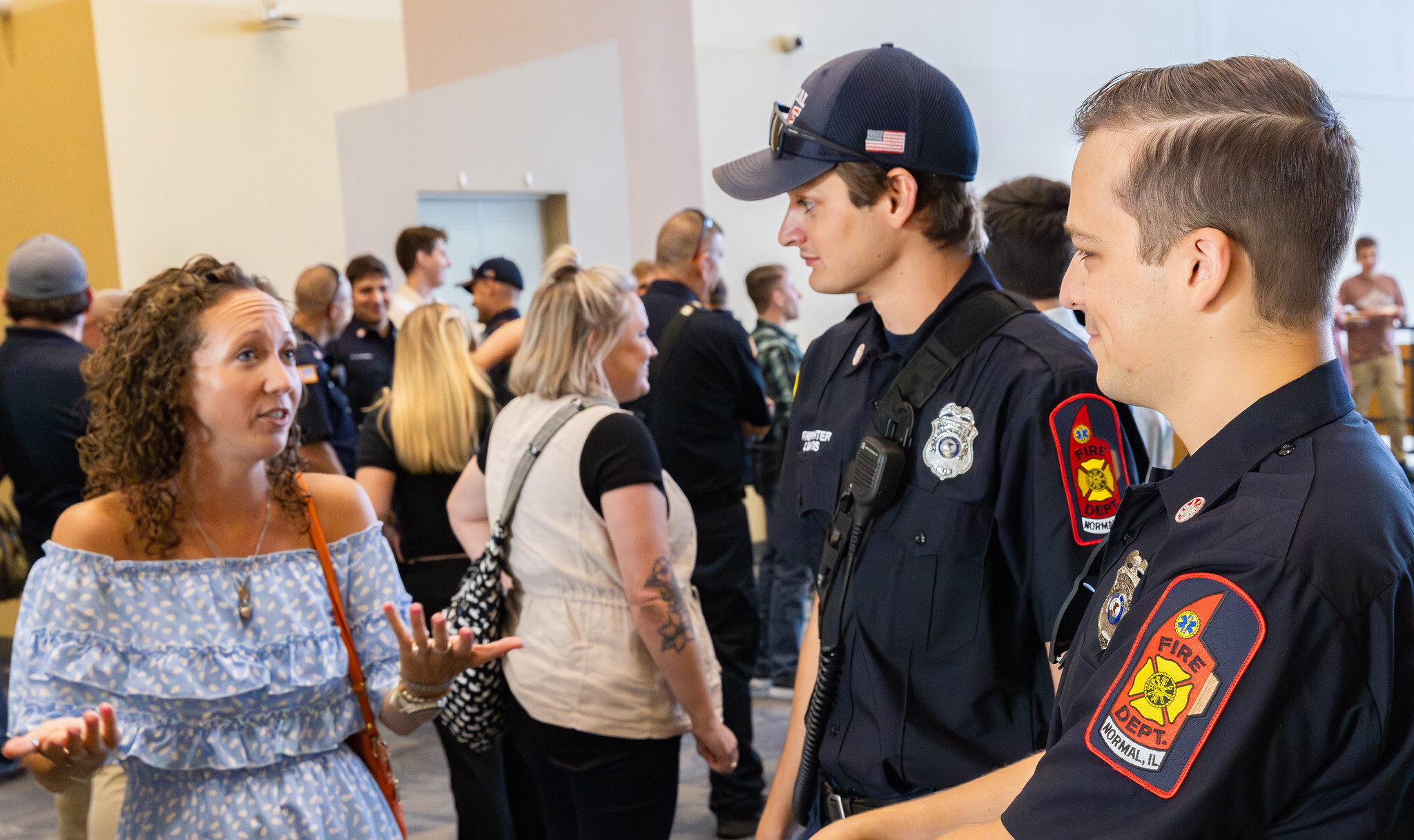
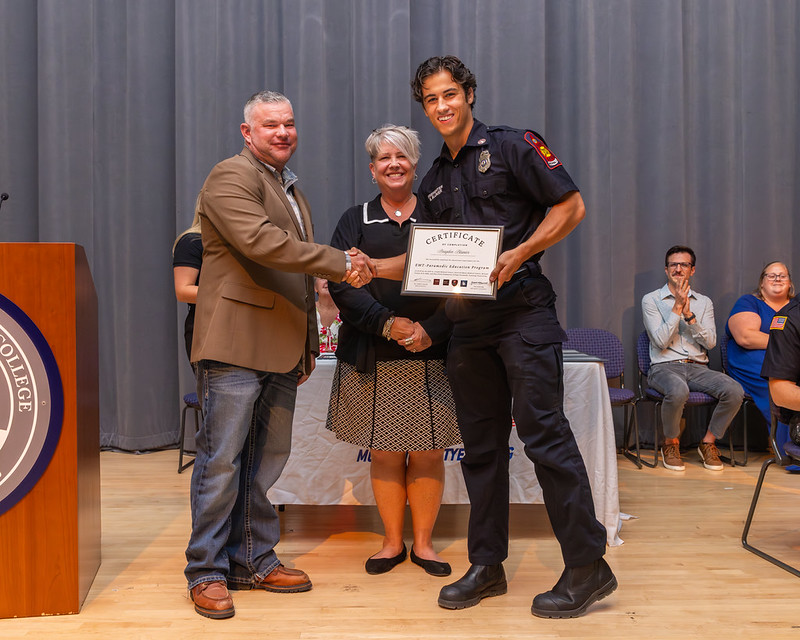
The EMT-Basic (EMT-B) program is designed to prepare students to enter the pre-hospital care field through classroom lectures, hands-on skills in lab settings, and field experience in hospital emergency rooms and with ambulance services/fire department EMTs.
Students who complete the Heartland Community College EMT-B Program are eligible to take the National Registry of Emergency Medical Technicians (NREMT) certification examination.
National Registry of Emergency Medical Technicians (NREMT) certification validates basic competencies in emergency medical services (EMS). However, it’s important to understand that NREMT certification alone does not grant you a license to practice in any state.
- NREMT Certification:
- The NREMT establishes standardized training and certification across the United States.
- Passing the exam demonstrates that you have met minimum EMS competency requirements.
- It is a national certification but does not automatically authorize practice in any state.
- State Licensure:
- You must obtain a state license from the Office of EMS in the state where you plan to work.
- Each state has its own requirements, regulations, and licensing process.
- A state license is what legally permits practice within that state.
- Reciprocity:
- NREMT certification can facilitate reciprocity in many states.
- Approximately 40 states recognize NREMT certification for reciprocity.
- Additional requirements (such as exams or continuing education) may still apply.
In summary, NREMT certification provides a foundation, but you must obtain a state license to practice. Always check with the state EMS office where you plan to work for current requirements.
Enrollment Requirements
To register for the EMT-Basic course EMT 101, students must meet the following requirements:
- Age 17 or older*
- High school diploma or equivalent**
* Per Illinois law, students who complete the program before age 18 may test but cannot be licensed until their 18th birthday.
** Students must possess a high school diploma or equivalent at the time of licensure application.
Registration for EMT 101 closes at midnight on the Sunday before classes begin.
Enrollment Considerations
Time Commitment
EMT 101 is an 8-credit/9-contact-hour course with 7 hours of lecture and 2 hours of lab weekly over 16 weeks. Students must also complete 28 hours of clinical experience in settings such as emergency departments, dispatch centers, and ambulances.
Essential Functions of the Job
Students must be able to perform the following with or without reasonable accommodations:
- Communicate effectively via telephone and radio
- Lift and carry up to 125 pounds (250 with assistance)
- Interpret oral, written, and diagnostic instructions
- Use sound judgment in high-stress situations
- Tolerate loud noises and flashing lights
- Read English materials and maps
- Discern street signs and addresses
- Demonstrate manual dexterity for patient care tasks
- Bend, stoop, and crawl on uneven terrain
- Work in extreme environmental conditions
- Operate in low-light and confined spaces
Students may contact Student Access and Accommodation Services with any concerns.
Clinical Requirements
Criminal Background Check
A background check is required for clinical participation. Students must complete authorization forms during the first week. View disqualifying convictions and waiver information .
Students with disqualifying results must complete a waiver before entering clinical settings.
Drug Testing
A 10-panel urine drug test is required for clinical participation.
Health Requirements & Immunizations
Proof of the following is required before clinical placement:
- TDaP vaccination within 10 years (or equivalent booster documentation)
- MMR (2 doses or positive titer)
- Varicella (2 doses or positive titer)
- Hepatitis B series and positive titer
- Two-step TB test (negative)
- Influenza vaccine (current year) or declination
- COVID-19 vaccine or declination
- Proof of health insurance
- Completed background check (Viewpoint Screening)
- Valid state ID, driver’s license, or passport